
Positive Behaviour Support (PBS) is a caring, evidence-based approach focused on understanding and reducing behaviours of concern while improving quality of life.
We support children and adults with tailored PBS strategies to meet a wide range of developmental, behavioural and support needs, including those with high and complex needs.
Supporting individuals with Positive Behaviour Support
Outcomes Connect supports individuals who experience behaviours of concern that may be challenging, disruptive or harmful and that can impact their wellbeing and the people around them. These behaviours often relate to unmet needs, communication difficulties, environmental stressors or underlying conditions.
We work with people who have:
- Neurological, Cognitive and Intellectual Disabilities
- Autism Spectrum Disorder
- Dual diagnosis
If you’re looking for NDIS positive behaviour support, submit a referral below or call us on 1300 622 287 to get started.
How a Positive Behaviour Support Practitioner can help
We start by understanding the why behind behaviour. Our Positive Behaviour Support Practitioners work closely with participants, families and support teams to identify triggers, needs and goals.
From there, we develop practical, evidence-informed behaviour support plans that focus on building skills, increasing independence and improving everyday quality of life. We provide clear strategies and consistent guidance across home, school and community settings, supporting everyone involved to achieve lasting, positive change.
NDIS Positive Behaviour Support Services
Positive Behaviour Support Practitioners play a vital role in supporting participants with behaviours of concern, helping them stay safe and build skills for everyday life.
Once a participant is referred, we begin by engaging with them, their family and their support network to understand their goals, needs and environment.
Alongside implementing practical strategies, behaviour support practitioners are also responsible for documenting their work and meeting the reporting requirements set by the NDIS Quality and Safeguards Commission.
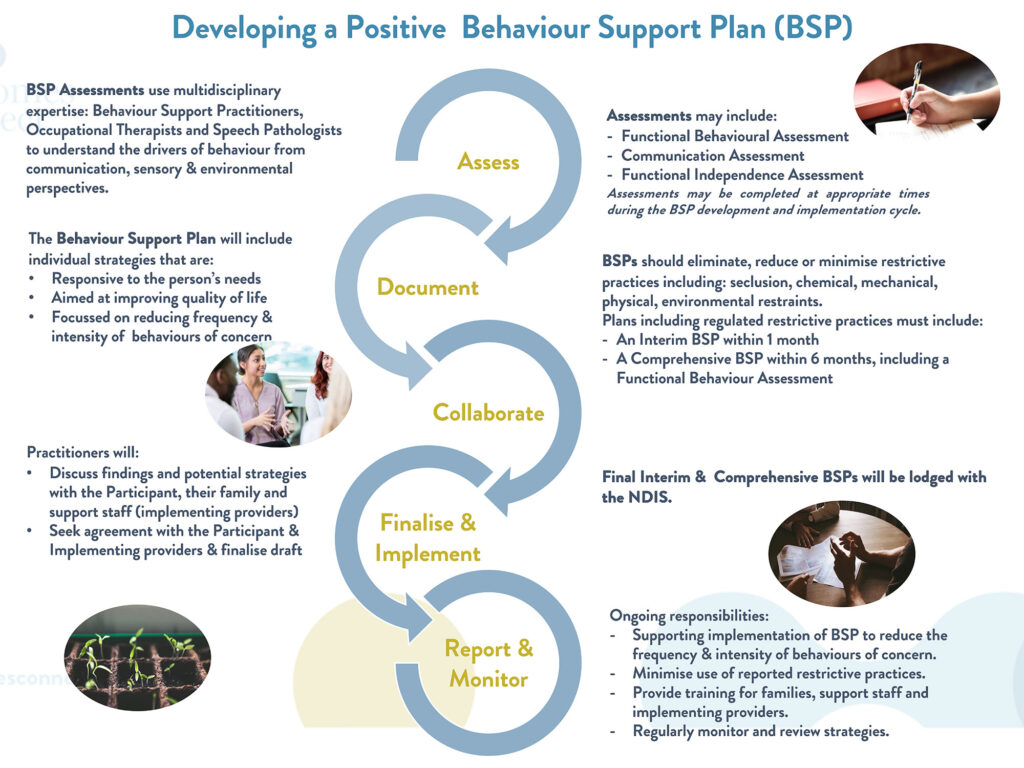
We’ve summarised the key stages of Positive Behaviour Support below:
1. Interim Behaviour Support Plan
Timeframe: Submitted within 1 month of service starting
If restrictive practices are in place, an Interim Behaviour Support Plan is required to ensure there is a short-term, legally compliant plan while the full assessment and planning are completed.
This plan outlines:
- Basic understanding of behaviour
- Immediate risk mitigation strategies
- Steps to begin skill development and build positive routines
2. Functional Behaviour Assessment
Timeframe: Completed within 6 months of service starting
A detailed Functional Behaviour Assessment is conducted to understand the reasons behind the participant’s behaviours of concern. This includes:
- Observations and data collection
- Interviews with the participant and key supports
- Identifying triggers, patterns, and the function of behaviour
The findings form the foundation of the Behaviour Support Plan.
3. Comprehensive Behaviour Support Plan
Timeframe: Finalised within 6 months of service starting
This is a detailed, individualised plan based on the Functional Behaviour Assessment and includes:
- Proactive and reactive strategies
- Skill-building approaches
- Supports required across settings (home, school, community)
- Plans for reducing restrictive practices, if applicable
- Roles and responsibilities of the support network
4. Ongoing Implementation & Support
The PBS practitioner works with the participant and their support team to put the plan into action. This includes:
- Training carers, educators, and support workers
- Providing visual supports or routines
- Coaching to ensure consistent, confident implementation
- Regular check-ins and monitoring
5. Progress Report
Timeframe: Typically due 6–12 weeks before the participant’s NDIS plan review
This report includes:
- Participant progress against PBS goals
- Outcomes of strategies used
- Recommendations for ongoing support
- Any updates or modifications to the plan
Why Trust Outcomes Connect Australia?
Choosing the right Positive Behaviour Support provider matters. At Outcomes Connect, quality, safety and professionalism guide everything we do.
Our practitioners are committed to delivering ethical, evidence-based support that meets NDIS expectations and puts participants first.
What sets our PBS practitioners apart:
- Extensive experience
Backed by a team with 20+ years of experience and tens of thousands of PBS hours, our behaviour support practitioners bring that experience to every interaction. - NDIS-aligned practice
All support is delivered in line with the NDIS Quality and Safeguards Commission requirements, including the use of evidence-informed, least-restrictive approaches. - Person-centred and ethical approach
Our behaviour support practitioners focus on understanding the underlying causes of behaviour, protecting rights and promoting dignity, choice and independence. - Collaborative and transparent
We work closely with participants, families, support workers and other professionals to ensure strategies are practical, consistent and sustainable. - Commitment to quality
Our behaviour support practitioners supported by rigorous training, professional development, and strong clinical oversight to support positive, participant-led outcomes. - Local expertise
Our practitioners live and work in your community, delivering real, face-to-face support.
If you’re looking for a trusted Positive Behaviour Support provider in Australia, Outcomes Connect offers experience, accountability and genuine care.
Positive Behaviour Support FAQs
Behaviours of concern are actions that might put a person or those around them at risk. These behaviours often come from unmet needs, like struggles with communication, sensory issues, pain, emotional distress or stress from the environment. They are not just ‘bad behaviours’, they are signs that something is wrong and support is needed. These behaviours can disrupt daily life, limit social activities or affect the quality of life for both the individual and their support network.
Some examples of behaviours of concern include:
- Physical aggression or self-harm
- Verbal outbursts or threats
- Damage to property
- Withdrawal or refusal to engage
- Risky or unsafe actions in public.
PBS seeks to understand why these behaviours happen and offers safe, respectful and personalised strategies to help the individual feel more supported, empowered and in control.
PBS is a person-centred approach that looks at why someone may show behaviours of concern, such as aggression, self-harm, withdrawal or difficulty communicating their needs.
Rather than simply trying to reduce these behaviours, PBS focuses on improving the person’s overall quality of life. It does this by identifying the underlying causes of the behaviour and developing strategies that promote positive, meaningful alternatives.
PBS aims to create supportive environments, teach new skills and tailor strategies to each person’s strengths, preferences and goals. It involves working closely with the individual, their family and their wider support network to ensure consistency and lasting change.
PBS is designed for anyone experiencing behaviours of concern that impact their quality of life. It’s especially helpful for people with disability, developmental delay, autism or complex support needs.
Families and support teams also benefit from PBS, gaining practical strategies, confidence and a shared understanding of how to provide consistent, effective support.
A Behaviour Support Practitioner is a skilled professional who works with people experiencing behaviours of concern to improve safety, wellbeing and quality of life.
A Behaviour Support Practitioner assesses behaviours of concern, identifies triggers and contributing factors and develops Positive Behaviour Support Plans. They collaborate with participants, families and support teams to implement practical strategies, reduce restrictive practices, monitor progress and ensure supports remain effective, and quality of life is improved.
Becoming a Behaviour Support Practitioner typically requires relevant tertiary qualifications, experience in disability or behaviour support and meeting the NDIS Quality and Safeguards Commission requirements. Most practitioners complete specialised behaviour support practitioner training, along with ongoing supervision and professional development. Career pathways and behaviour support practitioner salary levels can vary depending on qualifications, experience and registration status, with evidence-based practice being a core requirement of the role.
PBS equips individuals and their support networks with practical skills and proactive strategies to improve communication, reduce behaviours of concern and enhance quality of life. Here’s how:
- Functional Communication Skills
PBS helps individuals express their needs, wants and emotions in effective and socially appropriate ways. - Emotional Regulation
By understanding what triggers certain behaviours, PBS supports individuals to manage stress, anxiety, frustration or sensory overwhelm in calmer, more independent ways. - Social and Daily Living Skills
PBS builds everyday skills that promote confidence and independence, like making choices, following routines, problem-solving and interacting with others. - Consistent Support Strategies for Families and Carers
PBS offers training and guidance to carers, families and support networks to support consistent, confident implementation of behaviour support strategies. - Proactive Behaviour Strategies
Rather than reacting to behaviours after they occur, PBS focuses on prevention. This includes adjusting environments, teaching alternative skills and addressing everyday triggers.
In Positive Behaviour Support, evidence-based practice means using proven approaches that combine current knowledge, practitioner experience and the individual’s goals and preferences.
Practitioners focus on:
- What’s known to be effective through years of practical use and shared learning.
- Professional insight and judgement to apply strategies in safe, meaningful ways.
- The person’s own experiences, values, and input from those who know them best.
This approach helps ensure that support is not only effective but also relevant, respectful and tailored to each person’s unique needs.
Restrictive practices are actions taken to limit someone’s rights, movement or freedom, usually as a last option to prevent harm to themselves or others. These practices may be used in disability support when certain behaviours pose a serious safety risk.
Examples of restrictive practices may include:
- Physical restraint – holding or blocking someone to stop their movement.
- Mechanical restraint – using a device to limit movement, like straps or belts.
- Chemical restraint – using medication to manage behaviour, not to treat a health issue.
- Seclusion – keeping a person alone in a room or space they can’t leave.
- Environmental restraint – limiting access to parts of an environment, like locked cupboards.
Restrictive practices are strictly regulated under the NDIS and should only be used when necessary, for the shortest time possible and as part of a documented Behaviour Support Plan. The aim is always to reduce and eventually eliminate these practices by understanding the reasons behind certain behaviours and offering safer alternatives.
To qualify for NDIS funding, you need to meet some specific criteria from the National Disability Insurance Agency (NDIA).
Here’s a simple guide to NDIS eligibility criteria:
- Age: You must be under 65 years old when applying.
- Residency: You should be an Australian citizen, a permanent resident or hold a Protected Special Category Visa.
- Disability or Early Intervention — You need to:
– Have a permanent and significant disability that affects
your everyday activities; or
– Require early intervention to lessen the future impact of a disability or developmental delay.
– Impact on Daily Life: Your disability should affect your ability to work, study, socialise, live independently or care for yourself without help.
If you’re uncertain, the best step is to fill out the NDIS Access Request Form or talk to your healthcare provider for assistance. You can also check the NDIS website or call NDIS directly on 1800 800 110.
At Outcomes Connect, Positive Behaviour Support isn’t just something we do — it’s at the heart of who we are.
With years of experience and a community-based approach, we work alongside participants, families and support teams to deliver support that’s practical, personal and focused on long-term outcomes.
If you’re looking for NDIS Positive Behaviour Support that’s grounded in everyday life and built around what matters most to the individual, give us a call on 1300 622 287 or get in touch today to see how a Positive Behaviour Support Practitioner can help you or your loved one.